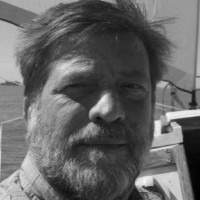
Collaborative systems · Information physics · Collective intelligence
Jim Whitescarver
Collaborative-systems and distributed-application specialist
Rho Vision
QLF · QuantumOS · EIES · ProvenSecure · RChain
Tampa, Florida · [email protected]
“A retired, passionate soldier in the war against entropy — promoting collective intelligence and loving life.”
Profile and method

I work on the question underneath collaboration: how can independent people — or independent processes — agree on something without a centre that everyone has to trust? My LinkedIn profile calls me a collaborative-systems and distributed-application specialist. The longer story is that I have been chasing that question since I was a kid who liked asking why.
I learned quantum physics and relativity on my father’s knee, built a crystal radio at seven, and argued in school that numbers produced by no algorithm were not real. After high school I studied electrical engineering at Widener, quit in 1968, hitchhiked to California, and came home by bicycle through Wyoming and Nebraska. I went back to school in 1970 to learn AI. At NJIT I landed in computer-mediated communication with Murray Turoff and Roxanne Hiltz. We built EIES — one of the first online conferencing systems — before the internet was a household word.
Murray gave me the mission I have been working on ever since: don’t build one computer as smart as a human; build a system that enables collective intelligence among humans. That mission has taken many forms: Interact and EIES, WikiWorld, FreeTrust, DivvyDAO, the RChain CoLab, RGov, and now QuantumOS. Some of those communities died. I have not given up on the question.
The other half — the physics — became the Quantum Logical Framework, which I began writing in earnest after retiring, when AI made the impossible possible. At the 2002 Science and Ultimate Reality conference, John Archibald Wheeler told me to carry the torch. Both halves of the dream are now running on the same logic.
I was at NJIT from 1974 to 2000 — first as a student, then directing EIES2 and running controlled studies in collective intelligence. I spent the next decades in consulting and security: ProvenSecure.com, travel and banking systems, transportation, and a DARPA-funded project using maximum relative entropy to quantify multifactor risk. That work led to AT&T Shannon Research Labs and a patent on authentication techniques utilizing a computing device. I live in Tampa, Florida, and have five children. Every commit still ends with a quiet “thanks, Dad” — and thanks to God.
What I work on
- Collective intelligence
- Systems that let a group be smarter than any member, without a centre that owns the answer.
- Collaborative systems
- Software that helps a group act together without requiring a single trusted centre.
- Distributed applications
- Systems whose parts can fail, disagree or disappear, and still have to behave.
- Formal foundations
- Claims that can be checked; limits that are stated before the architecture.
- Community tooling
- Lowering the cost of participation, so the people affected can test the idea.
Selected work
-
Quantum Logical Framework A constructive foundation for physics and mathematics, built from one bit and Zero Free ActionRecord →
-
QuantumOS A peer-to-peer room where identity, messages, claims and value are capability tokensRecord →
-
EIES / Interact One of the first online conferencing systems, and a user-programmable interface languageRecord →
-
ProvenSecure.com Security and risk consulting across travel, banking, transportation and a DARPA-funded MRE projectRecord →
-
RGov & RChain User-programmable group communication with rank-order voting, chat, multisig and trust networkingRecord →
-
Rho-bot & CoLab tools A Discord-to-RChain bridge, dashboards, voting and libraries for a cooperativeRecord →
-
Social Ledger A way to make the intangible parts of social capital visible and accountableRecord →
-
FreeTrust, DivvyDAO & Digital Life A web of trust, a member-community experiment and a project-registration workflowRecord →
Chronology
| Period | Work |
|---|---|
| 1968 | Left Widener College; hitchhiked to California, returned by bicycle through Wyoming and Nebraska, and met his wife at Widener. |
| 1970 | Returned to school to study AI. |
| 1974–2000 | NJIT: studied computer science (1974–1979), then EIES2 and controlled studies in collective intelligence. |
| 1995–2010 | Independent consulting and ProvenSecure.com: travel fulfilment, online banking, transportation and security; DARPA grant using MRE for multifactor risk quantification. |
| 2002 | Attended the Science and Ultimate Reality conference at Princeton; John Archibald Wheeler told him to “carry the torch.” |
| 2010–2015 | AT&T Shannon Research Labs: multifactor risk analysis and voice, video and device authentication. Patent filed 2011, granted 2015; WATSON Voice Biometrics API project 2013. |
| 2015–2023 | Senior Fellow at Proven Secure Solutions Inc. |
| 2016 | FreeTrust; began volunteer work as leader of DivvyDAO.org. |
| 2017 | Digital Life Collective project-registration workflow. |
| 2018–2022 | RChain CoLab and RGov with Dan Connolly; rho-bot, rchain-tools, rv2020, community-wallet, librho. |
| 2019 | Social Ledger with Joachim Stroh at ITP Camp. |
| 2023 | “Decentralized Cooperation” published on LinkedIn. |
| 2026 | QLF (March) and QuantumOS (May). |
Security, consulting and patents
ProvenSecure.com is the record of my security and risk work: independent consulting from 1995 to 2010 across travel fulfilment, online banking, transportation and security; a DARPA cybersecurity grant using maximum relative entropy (MRE) to quantify multifactor risk; AT&T Shannon Research Labs (2010–2015); and later, Senior Fellow at Proven Secure Solutions Inc. (2015–2023). The DARPA/MRE work preceded and informed the multifactor risk analysis at AT&T Shannon.
- ProvenSecure.com
- Security and risk consulting, 1995–2010: travel fulfilment, online banking, transportation and security systems.
- DARPA
- Cybersecurity research grant (pre-2010) using maximum relative entropy (MRE) for multifactor risk quantification, prior to the AT&T Shannon Research Labs work.
- AT&T Shannon
-
AT&T Shannon Research Labs, 2010–2015: multifactor risk
analysis and early authentication for voice, video and
devices.
Co-inventor on US 9,021,565 B2, “Authentication techniques utilizing a computing device” (filed 2011, granted 2015).
AT&T Watson Voice Biometrics API (2013). - Proven Secure Solutions
- Senior Fellow at Proven Secure Solutions Inc., 2015–2023.
Dates and roles from public profile records and MyStory.md; patent record from Google Patents.
Elsewhere
- GitHub — @jimscarver · 41 public repositories and the organisation work behind QLF and QuantumOS.
- My Story — the personal origin story behind QLF.
- LinkedIn — /in/jimscarver · the professional record and recent notes.
- Quora — Jim Whitescarver · answers on physics, spin and relativity.
- Facebook — Jim Whitescarver.
- Email — [email protected] · best for direct correspondence.
Research programme · 2026–
Quantum Logical Framework
A constructive foundation for mathematics and physics, built from one finite distinction: one bit, one Zero-Free-Action event.
The one idea
QLF starts from a fact about measurement, not a claim about physics: no measurement has ever produced a real number. Every outcome is a count plus a rational interval. From that starting point it builds a finite, computable substrate in which propositions are phase-string distinctions and truth is decided by measurement — a Zero-Free-Action closure.
The primitive is a half-spin closure: one bit of distinction,
log 2, that closes only when its action balances.
Spacetime, matter and the constants are then supposed to
follow, rather than be assumed.
What the repository reports
sorry proofs.
α = 1/137 and
m_p/m_e = 6π⁵.
| Claim | What the repository reports |
|---|---|
| Formal core |
More than 200 Lean modules with zero
sorry proofs; the combinatorial core sits
within RCA₀ (no Axiom of Choice, no continuity).
|
| Quantum logic |
The minimal quantum logic MO2:
orthocomplemented, orthomodular, and provably
non-distributive, with no bridge axiom.
|
| Constants |
α = 1/137 and
m_p/m_e = 6π⁵, reported from ZFA + h with no
free parameters. Ω_Λ ≈ log 2 is described in
the README as an observed match, not a derivation.
|
| Millennium problems | Reformulated as verified discrete cores plus one named continuum boundary — explicitly not a claim to have settled the Clay statements. |
| Empirical posture | Exclusivity — that only ZFA is happening — is a published conjecture with named defeaters, not a theorem. |
Characterisations and figures follow the QLF README; the proofs are the authority.
How to check it
- Clone the repository. Everything needed to check the claims is in the tree.
-
Run
lake build. The proofs check or they do not. - Read the short route in. Introducing_QLF.md gives the idea; Completeness_Evidence.md gives the method and the limits.
- Read the defeaters. Positioning.md states what would count against the programme. That is the part worth checking first.
git clone https://github.com/rhovision-org/quantum-logical-framework
cd quantum-logical-framework
lake buildWhere it could be wrong
Source: the QLF README and
Completeness_Evidence.md §4c.
Where it came from
QLF did not arrive suddenly. It began on my father’s knee — he taught me relativity and quantum physics, wrote to Einstein, and taught me to distrust secondhand claims about Einstein. It continued through a childhood protest that “real numbers” were not real, a senior-year proof of the fundamental theorem of calculus using difference tables, EIES, the Electronic Information Exchange System, Murray Turoff’s collective-intelligence mission, and a long argument about black holes, spin, and local time.
At the 2002 Science and Ultimate Reality conference in Princeton, John Archibald Wheeler told me to “carry the torch.” MyStory.md is the full route: the physics, the communities, the dead ends, and the return. It is the personal record behind the proofs on this page.
“The torch Wheeler told me to carry is lit at both ends.
Thanks, Dad. Thanks, Murray. Thanks God.”
What to open first
- The live index — the project’s own front door.
- FlowChart — the whole framework as one clickable map.
- Spectral Spacetime Constructor — space as node position, time as clock rate, both shown as frequency.
- The Fredkin Machine — conservative logic on the QLF substrate.
- README — the long version, with the module table and headline results.
- Introducing QLF — a short, link-rich introduction for the general reader.
Peer-to-peer software · 2026–
QuantumOS
A room is not a chat channel. It is a shared process space, verified peer to peer.
What it is
QuantumOS is a peer-to-peer layer for people and agents to meet in rooms. Every identity, message, claim and unit of value is a capability token whose validity is an algebraic fact, not a policy someone has to enforce. In practice: zero-trust peer-to-peer with capability tokens standing in for ACLs, sessions and TLS at once.
To an engineer, the claim is narrow and checkable. To anyone else, it is simpler: reaching another person and reaching the truth, the agreement or the value between you are the same verified act.
A room, concretely
- Open the live app. No install is required.
- Click Connect. The room is identified by a ZFA capability token in the URL hash; your peer ID is a ZFA-balanced process.
- Share the link. A second peer connects and appears in the Peers list.
-
Read the Room Process panel.
It shows the combined
parallel(you, peer)process — balanced by construction. -
Run a QLF command.
Try
/braket +or/qucalc ^v; output broadcasts to every peer.
The security model
| Layer | What the project says |
|---|---|
| Off-chain default | Rooms, capability tokens, lemmas, notes, polls, rendezvous swaps, governance and the file library are verified peer-to-peer. No consensus or ledger is required. |
| Quantum-secure where it counts | Capability tokens, dyncap identity and the identity vault are built from CSPRNG entropy, SHA-256 and AES-256-GCM — no factoring or discrete-log keypair for Shor’s algorithm to break. |
| Opt-in chain |
/rholang deploys, the pooled token exchange
and wrapped native tokens reach for the chain
deliberately. That path uses secp256k1 and carries the
classical exposure every blockchain has today.
|
Source: the QuantumOS README and SECURITY.md.
What to try
Status
QuantumOS is running code, not a design document. The guides separate what is implemented from what is planned; the roadmap is the only place a design lives without an implementation behind it. The ZFA kernel is Rust/WASM, transport is WebRTC data channels, and the signalling server is self-hosted.
The room is the unit of cooperation. Open one with someone and the process you share is no longer a metaphor: it is the thing the software is evaluating.
Community & tooling · 2018–2022
RChain and the rho-calculus
A blockchain built around concurrent processes, formal semantics and object capabilities — and the community tools that made it testable.
The bet
RChain’s bet is that smart contracts should be concurrent processes with formal semantics, not sequential programs on a shared ledger. Rholang is the surface language; the rho-calculus is the model. Authority is held as an unforgeable name rather than an administrator account, which changes what a contract can be trusted to do.
RChain was also the latest stop in a longer search for a better communication language: Interact in EIES, Hoare’s communicating sequential processes, Milner’s pi-calculus, and then Greg Meredith’s rho-calculus. The orchestration systems I had worked with were mathematically wrong. The rho-calculus was the first model that fit both human and quantum communication.
Rho-bot
Rho-bot was a Discord interface to an RChain node. It let a
community define parameterised rholang snippets as macros,
then use them like commands — newBallot,
vote, voteresults — without learning
rholang first. The point was not to hide the language. It was
to let a group test governance contracts and take its own
temperature before asking anyone to trust the result.
newBallot: "colors", Set("red", "green", "blue")
vote: "colors", "green"
voteresults: "colors"
MacRhoLang commands from the rho-bot README. The bot could also deploy and propose blocks.
RGov and the tools for a cooperative
With Dan Connolly, RGov was a secure, user-programmable group communication prototype with rank-order voting, chat, multisig wallets and trust networking. It was the closest thing to EIES3 before QuantumOS — and when RChain died, the design survived into it.
| Repository | What it did |
|---|---|
| rgov | Secure, user-programmable group communication with rank-order voting, chat, multisig wallets and trust networking. With Dan Connolly; 2018–2022. |
| rho-bot | MacRhoLang Discord bot: expands macros, evaluates rholang, deploys and proposes blocks. C and JavaScript; 2019–2022. |
| rchain-tools | Personal RChain dashboard; page one was a bounty dashboard. Developed in the CoLab; 2018. |
| rv2020 | Voting dapp for the cooperative’s 2020 board election and items of business; 2020. |
| community-wallet / rui | Light-wallet work: keystore import, balance checks and REV transfers; 2021. |
| librho | A standard library for Rholang; 2018. |
| rhobash | Rho-calculus bots in bash; 2019. |
| nth-caller-game | A small RChain DApp game: be the nth caller to win. |
| rchain-dbr | Distributed budgeting and rewards bounty site, built in the CoLab. |
The CoLab
Much of this was built in the RChain CoLab, a collaborative learning work-study space. The method was simple: pick a real need, build the smallest thing that meets it in public, and let the next person improve it. Rho-bot, the bounty dashboard, the library and the voting app were all products of that method.
The through-line
RChain taught me the question QLF and QuantumOS now answer at different layers: how do independent processes coordinate without a trusted centre, and how do you know the coordination is correct? The chain was the first place I could test that question with other people, in public, against a real node. RGov carried the group-communication design forward; QuantumOS is where it finally became EIES3.
Cooperation · 1970s–
Collective intelligence
The social layer of the same problem: how groups make sense together without surrendering their independence.
EIES and Murray Turoff
At NJIT I landed in computer-mediated communication with Murray Turoff and Roxanne Hiltz. We built EIES — the Electronic Information Exchange System — one of the first online conferencing systems, connecting Mailnet, Bitnet, Arpanet and the commercial packet-switched networks before the web.
I developed Interact, an interface language that let groups build their own groupware on top of EIES. Thousands of commands were written largely by the users themselves. Murray gave me the mission I have been working on ever since: “You can spend your whole life building one computer as smart as a human, or you can build a system that enables the collective intelligence among humans.”
The results were largely forgotten; the questions were not. That thread later became WikiWorld, FreeTrust, Dividao and the RChain CoLab. Some of those communities died. I have not given up on the question.
The experiments
| Experiment | What it tried |
|---|---|
|
EIES / Interact 1970s–1980s |
Online conferencing and a user-programmable interface language; Mailnet, Bitnet and Arpanet connected before the web. |
|
FreeTrust 2016 |
A voluntary web of trust with blockchain provenance, Synereo login, UMA and trustworthy anonymous identity. |
|
DivvyDAO 2016– |
Member communities and a disintermediated organisational support infrastructure; volunteer leader since June 2016. |
|
Digital Life Collective 2017 |
A GitHub-based project-registration workflow: the record is the pull request. Served as a director. |
|
RChain CoLab / RGov 2018–2022 |
Rank-order voting, chat, multisig wallets and trust networking for a user-programmable group; with Dan Connolly. |
|
QuantumOS 2026– |
EIES3: serverless, capability-secure rooms where people and AI agents are full members. |
The through-line is described in more detail in MyStory.md.
Social Ledger
With Joachim Stroh, I presented the Social Ledger at ITP Camp 2019. It is a way to make the intangible parts of social capital — trust, reciprocity, belonging, stewardship — visible and accountable, alongside the financial and human capital a group already tracks.
Decentralized cooperation
In 2023 I published an essay on LinkedIn: “Decentralized Cooperation: Merging Marxist Solidarity, Randian Self-Determination, and Lewisian Humanism.” It is an attempt to find a common grammar for three traditions usually set against one another: solidarity, self-determination and humanism. The technical work on this site is one way of taking that essay seriously.
The essay is the political companion to the technical work: it asks what a group would have to believe about itself before it could hold its own record.
Why it belongs here
QLF is the formal substrate; QuantumOS is the coordination layer; the Social Ledger and the community work are the human question they serve. QuantumOS is EIES3 — the room Murray Turoff’s mission pointed toward, finished in a way he never got to see. A group that cannot keep a record cannot cooperate. A record that cannot be checked is not a record.
Notes & answers
Writing
Short notes on QLF and QuantumOS, the personal origin story behind the framework, a longer essay on cooperation, and years of physics answers on Quora.
Recent notes
| Date | Note |
|---|---|
| Why is mathematics so unreasonably effective in physics? | |
| QLF derives physics and math from one bit + Zero Free Action | |
| The Information Bang | |
| Quantum AI now, in QLF / QuantumOS | |
| The electron is not a point particle | |
| QLF’s scientific approach |
My Story
My Story
Quantum Logical Framework · version 0.7 · 18 June 2026
The personal origin story behind QLF: a father’s knee, a crystal radio, EIES, Wheeler’s torch, the communities that died, and the AI-assisted return. It is the long version of the Profile tab.
Essay
Decentralized Cooperation: Merging Marxist Solidarity,
Randian Self-Determination, and Lewisian Humanism
LinkedIn · 6 September 2023
An attempt to find a common grammar for solidarity, self-determination and humanism, and to ask what a decentralised organisation would have to look like if all three were true at once.
Quora
For years I answered questions on Quora about relativity, spin, spacetime and the geometry of physics. The answers are informal, but they show the route: take the measurement seriously, and the continuum starts to look like a convenience rather than a foundation.
“I learned relativity on my dad’s knee 60+ years ago.”
- Why is electron spin denoted by the quantum number 1/2?
- Jim Whitescarver on Quora — the full profile.
Code as writing
The repositories are the other half: rho-bot, rchain-tools, rv2020, community-wallet, librho, rhobash, and the QLF and QuantumOS codebases. Each one is an argument you can run.
Contact
Correspondence
Email is the fastest way to reach me. For QLF or QuantumOS, an issue in the repository is often better.
Write to me
Good reasons to write: a proof that does not check, a claim in QLF that needs a sharper defeat condition, a room in QuantumOS that behaves badly, a community tool that could be useful, or a question about the older work.
Elsewhere
- GitHub — @jimscarver · 41 public repositories and the organisation work behind QLF and QuantumOS.
- LinkedIn — /in/jimscarver · the professional record and recent notes.
- Quora — answers on physics, spin and relativity.
- Facebook — the personal feed.
- Email — [email protected] · best for direct correspondence.
About this page
Built as a static site, set in IBM Plex Mono, with no trackers and no build step. The record is the point; the window is just a way to read it.
Last updated November 2026. The source is on GitHub.